|
Project name: Zhuhai Jinwan Civic Art Centre
Architect: Zaha Hadid Architects
Design Principal: Zaha Hadid and Patrik Schumacher
Project Directors: Satoshi Ohashi, Charles Walker
Project Associate Directors: Lydia Kim, Yang Jingwen
Project Associates: Mei-Ling Lin, Aurora Santana [SD]
Location: Zhuhai, China
Project Team: Armando Bussey, Marius Cernica, Grace Chung, Nelli Denisova, Xuexin Duan, Kaloyan Erevinov, Nassim Eshaghi, Kate Hunter, Yang Jingwen, Reza Karimi, Ben Kikkawa, Lydia Kim, Julian Lin, Mei-Ling Lin, Valeria Mazzilli, Sareh Mirseyed Nazari, Massimo Napoleoni,Satoshi Ohashi, Yevgeniya Pozigun, Qi Cao, Qiuyu Zhao, Aurora Santana, Hannes Schafelner, Michael Sims, Patrik Schumacher, Sharan Sundar, Maria Touloupou, Chao Wei, Charles Walker, Kai-Jui Tsao, Yuling Ma, Feifei Fan
Photos: Virgile Simon Bertrand, Seilao Jiong, CAT-OPTOGRAM STUDIO, Yipeng Lyu
מרכז האמנות האזרחית ג'והאי ג'ינואן, שעוצב ותכנן על ידי משרד זאהה חדיד אדריכלים כמרכז של יצירתיות עכשווית באחד מהאזורים הדינמיים ביותר בעולם, נמצא בלב ליבה של עיר התעופה החדשה, עירוניזציה עם שטח בנוי של 4.78 מיליון מ''ר המאכלס 100,000 תושבים ומשלב אזרחים חדשים. תשתית תרבותית, אקדמית ומסחרית בתוך מחוז ג'ינואן של ג'והאי.
The Zhuhai Airport Railway, an extension of the Guangzhou- Zhuhai Intercity Railway, provides direct connections with Zhuhai’s city centre and its airport, while the new Hong Kong-Zhuhai-Macau bridge enables those in Shenzhen and Hong Kong to reach Zhuhai in less than an hour.Integrating three distinct cultural institutions for the city [a Performing Arts Centre with a 1200-seat Grand Theatre and a 500-retractable-seat multifunctional Black Box theatre; an interactive Science Centre; and an Art Museum] each venue within the Zhuhai Jinwan Civic Arts Centre incorporates unique characteristics that create differing visitor experiences, yet all are united by a coherent formal and structural logic that spans 170 meters wide from east to west and 270 meters long from north to south.
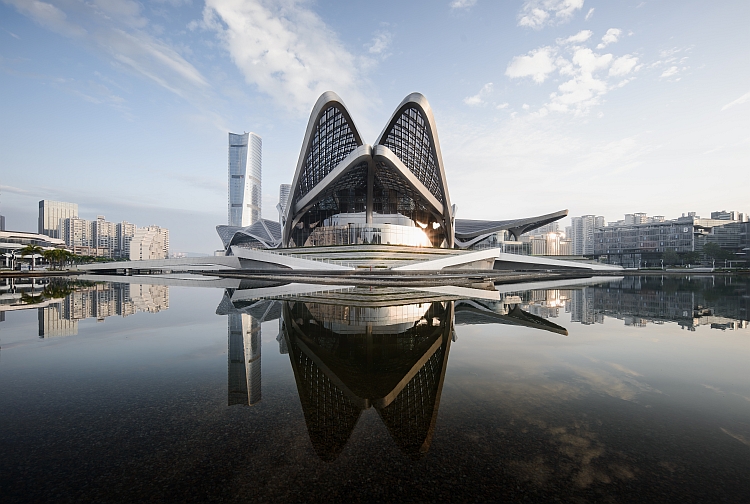
Photo Credit: CAT-OPTOGRAM STUDIO
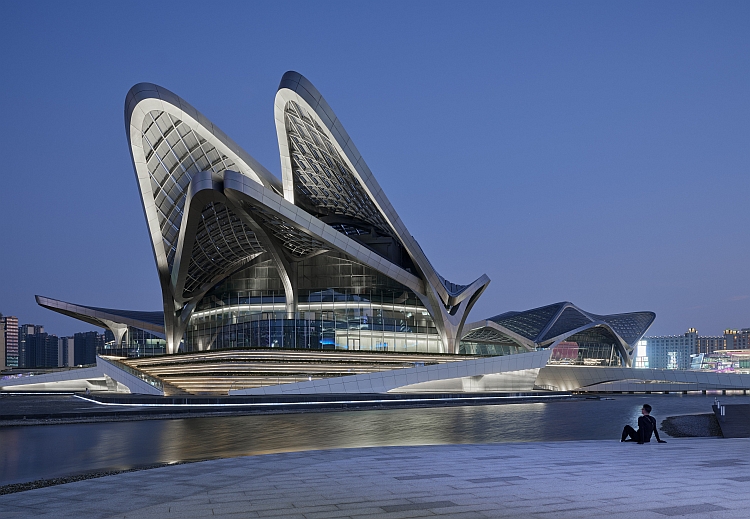
Photo Credit: Virgile Simon Bertrand
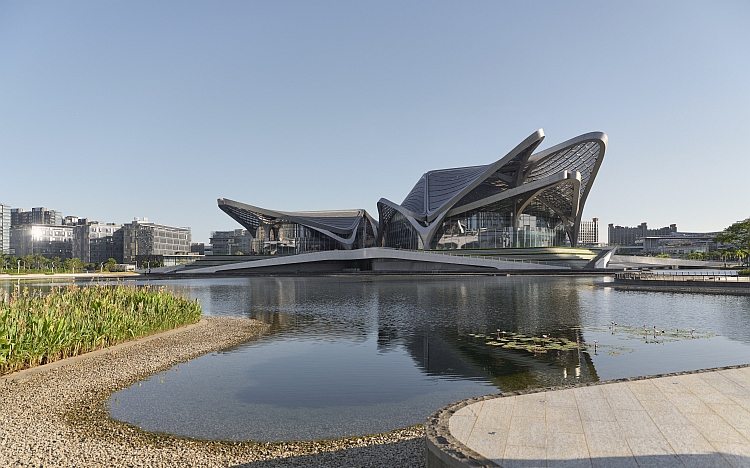
Photo Credit: Virgile Simon Bertrand
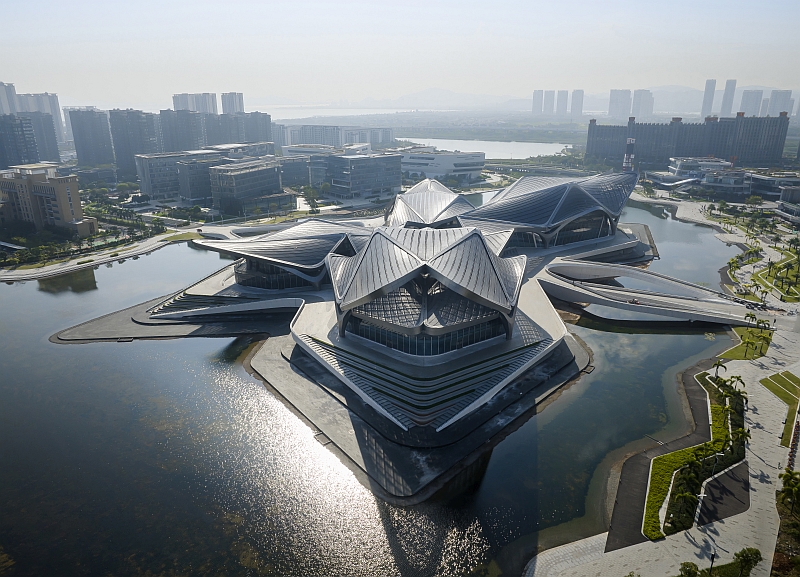
Photo Credit: CAT-OPTOGRAM STUDIO
Arranged symmetrically on a central axis, the two larger and two smaller venues are connected by a central plaza that serves as a shared external foyer to all of the cultural institutions. Glazed walls facing this courtyard enable visitors to determine the individuality and character of each venue. The Grand Theatre and Art Museum are finished in a light palate of materials, while the multifunctional Black Box Theatre and Science Centre are composed in darker materials.
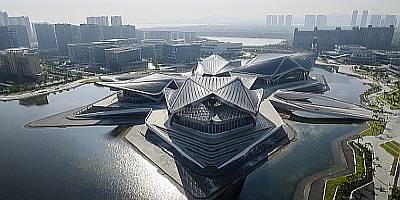
Echoing the chevron patterns of migratory birds flying in formation over southern China, the latticed steel canopies sheltering each venue are configured through repetition, symmetry and scale variation; resulting in a composition of related elements that respond to the different functional requirements of each building. This repetition of the self- supporting and self-stabilising roof modules optimised pre-fabrication, pre-assembly and the use of modular construction.The distinctive roof structure unites the different venues under a network of reticulated shells that envelop the four wings of the centre. Interconnecting bridges and voids create a multi-layered public plaza at the heart of the centre with views to the interiors as well as to the surrounding promenades with their cafés,restaurants and educational facilities. The design optimizes intuitive navigation with natural light in all public areas to enhance connectivity; creating engaging civic spaces for local residents to enjoy throughout the day and evening. The Grand Theatre’s interior continues the composition of the centre’s external roof canopy with the location and angle of ceiling panels optimised as sound reflectors. The Grand Theatre’s sound absorbing surfaces are designed to meet the highest acoustic standards required for local, national and international performances. The Art Museum adapts the chevron geometries of the roof to frame the main atrium which provides natural light to the
museum while at the same time creating a continuous vertical surface to display artworks.
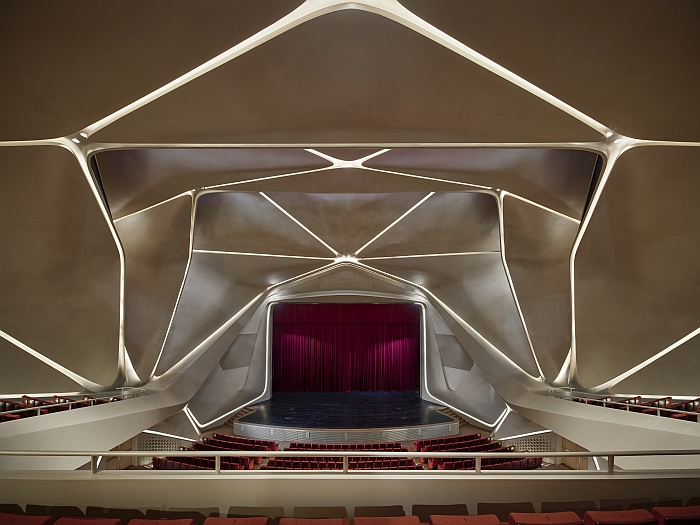
Photo Credit: Virgile Simon Bertrand
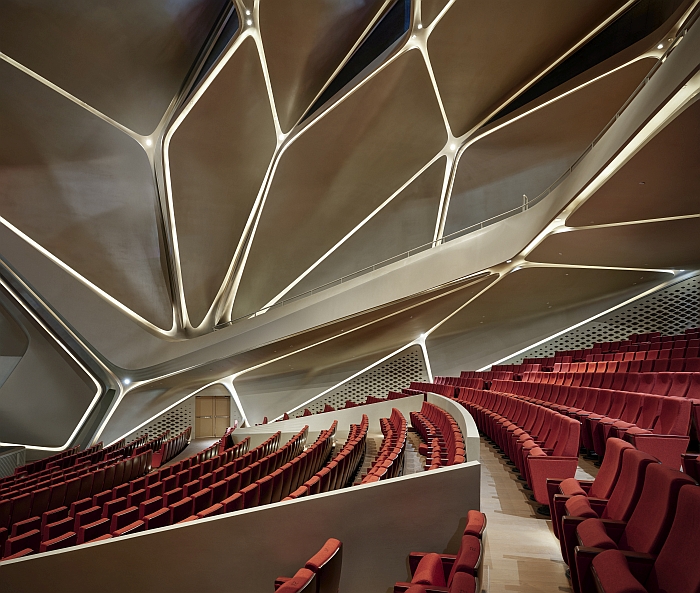
Photo Credit: Virgile Simon Bertrand
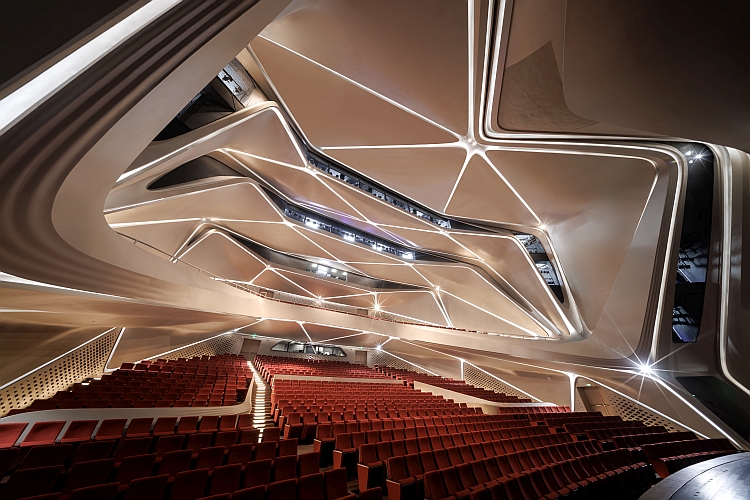
Photo Credit: Virgile Simon Bertrand
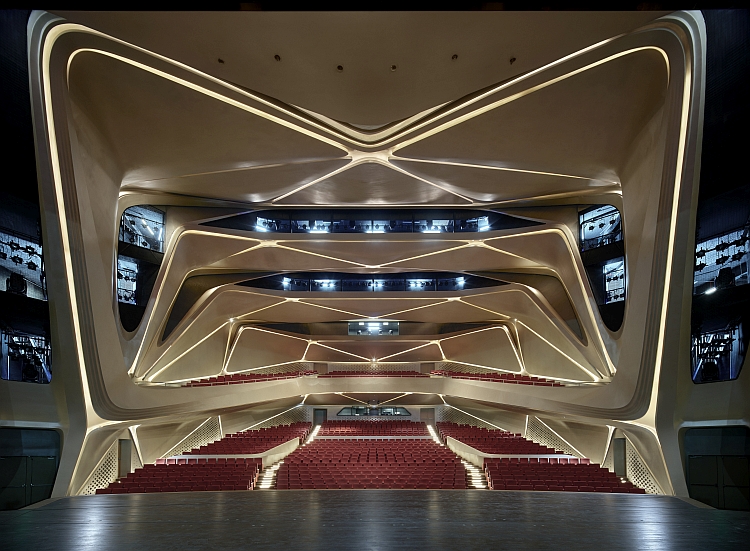
Photo Credit: Virgile Simon Bertrand
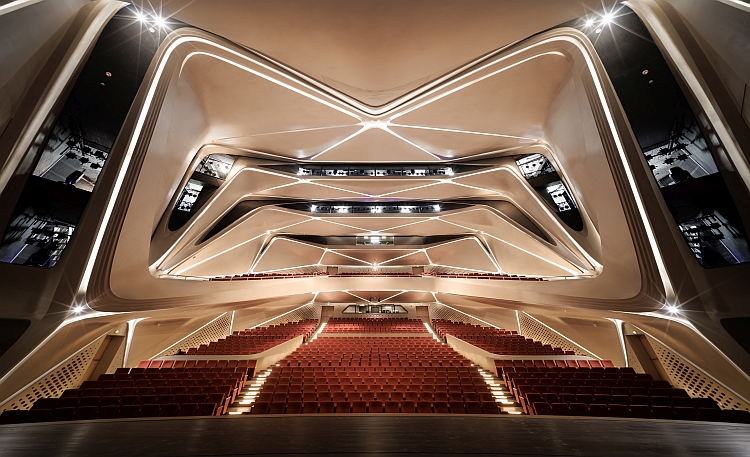
Photo Credit: Seilao Jiong
An internal gallery, storage and administrative spaces are located behind this vertical division. Merging architecture with exhibition experience, a continuous white ‘ribbon’ of museum’s vertical circulation and exhibition route is its’ defining feature. The Science Centre’s interior also translates the geometry of the centre’s roof to showcase scientific innovation with interactive exhibits that inspire curiosity and learning. The Science Centre’s lecture hall is designed for the centre’s programme of public demonstrations of scientific experiments and discovery.
Zhuhai Jinwan Civic Art Centre’s podium defines an island within ZhongXin Lake. Pedestrian ramps and tunnels invite visitors to cross the lake’s surface to the podium’s central public plaza where footbridges connect through voids to each venue. Glazed façades sheltered by the modular roof canopy provide transparency and welcome the local community onto lakeside boardwalks and plazas beneath the sweeping roof structure. An external amphitheatre on the west side of the centre allows for outdoor performances and activities.
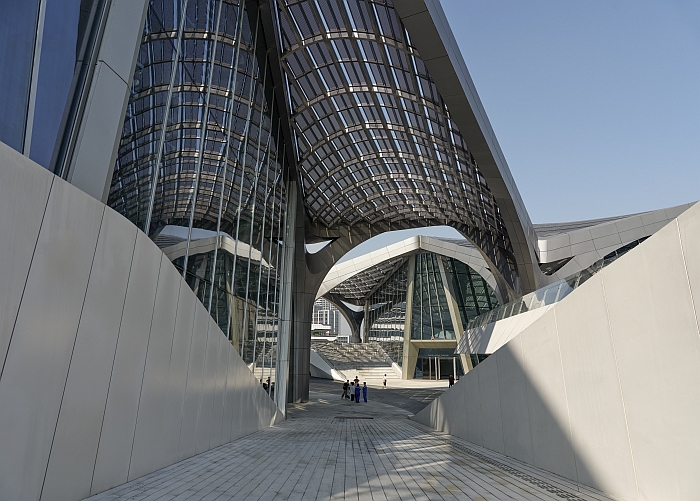
Photo Credit: Virgile Simon Bertrand
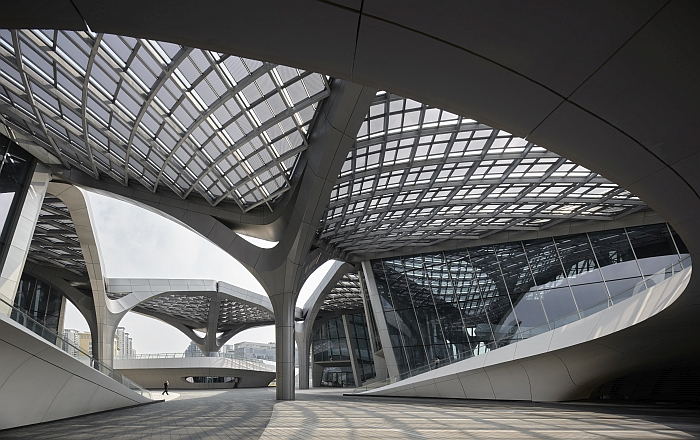
Photo Credit: Virgile Simon Bertrand
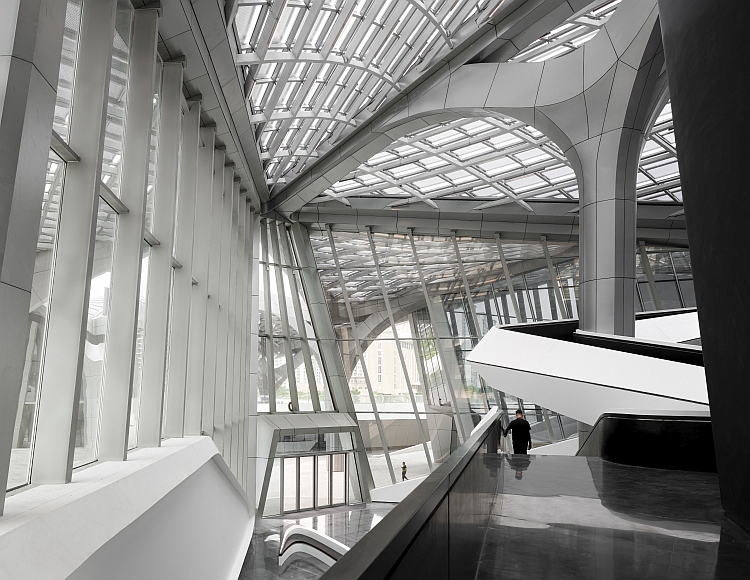
Photo Credit: Virgile Simon Bertrand
Constructed in concrete, the centre consists of five structurally separate buildings, each with its own self-supporting external steel canopy. Supported by only 22 columns and spanning a total of 270m x 170m, these free-formed steel roof canopies are composed of symmetrical geometries to enable their modular, repetitive structures to be fabricated off-site and assembled from only two different column types. The centre’s landscaping and surrounding lake are designed as integral elements within Zhuhai’s ‘sponge city’ initiative that targets the natural permeation, storage and re-use of at least 70% of the city’s rainwater using aquatic flora and fauna to naturally
filter contaminants. Humidity and soil-moisture sensors within the landscaping’s irrigation system control and reduce water consumption.
Located within the subtropical climate of coastal southern China, the double- insulated glazing of the building’s envelope is optimized for thermal performance and protected by the latticed roof canopy which incorporates perforated aluminium panels for external solar shading. The perforations within the panels vary in size to allow differing degrees of sunlight within the centre’s interior spaces in accordance to their programming requirements, orientation and solar gain. At night, this roof canopy bathes the centre in soft reflected light.
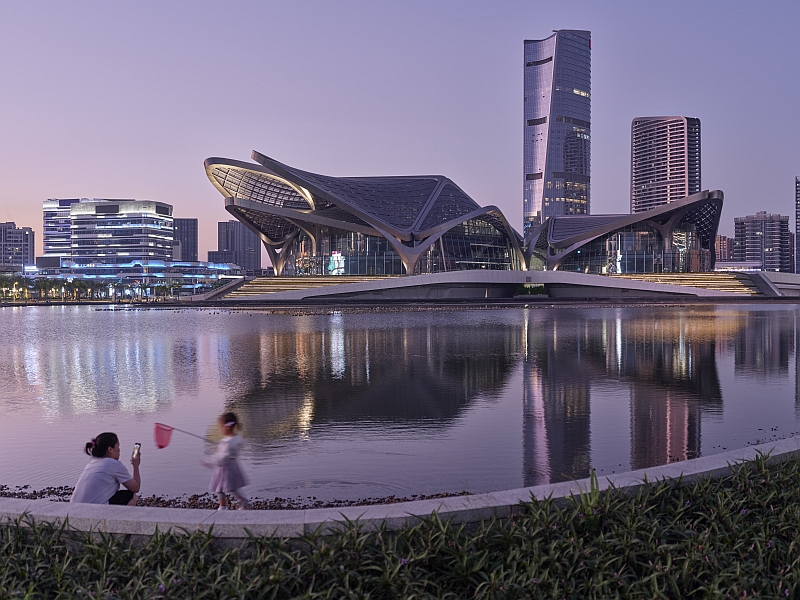
Photo Credit: Virgile Simon Bertrand
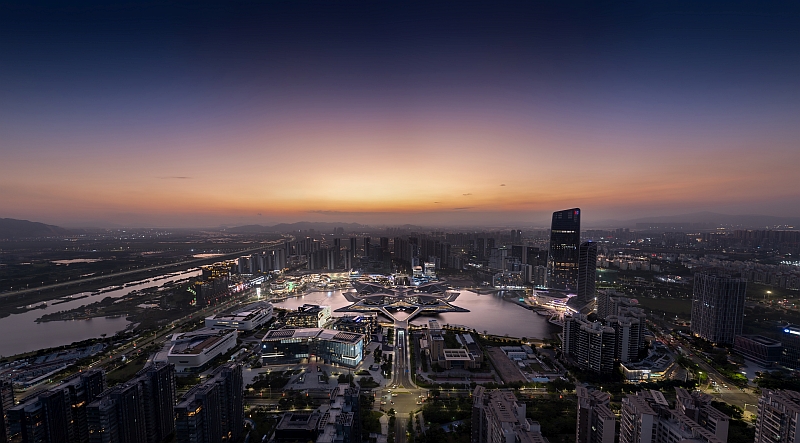
Photo Credit: Yipeng Lyu
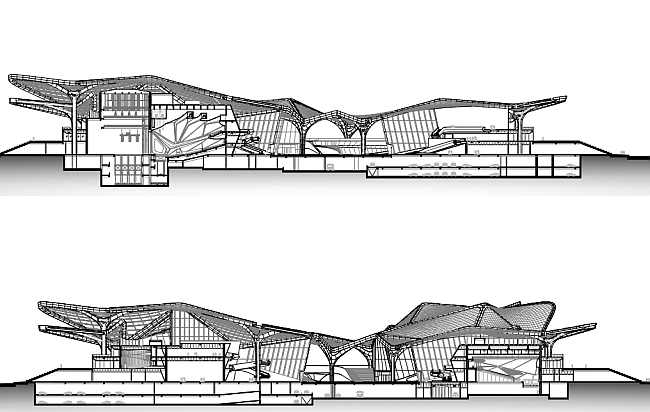
Photo Credit: Zaha Hadid Architects
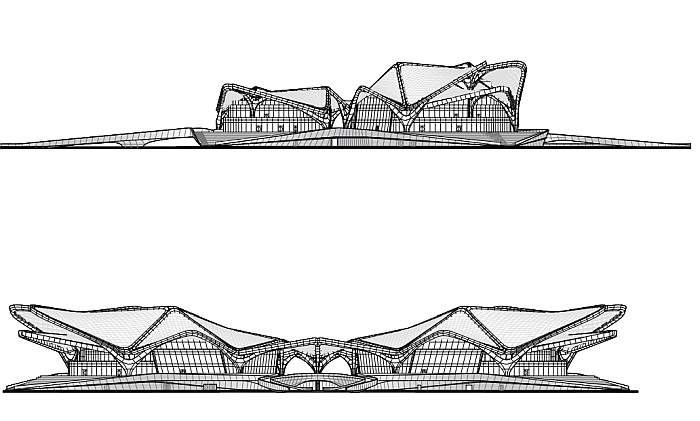
Photo Credit: Zaha Hadid Architects
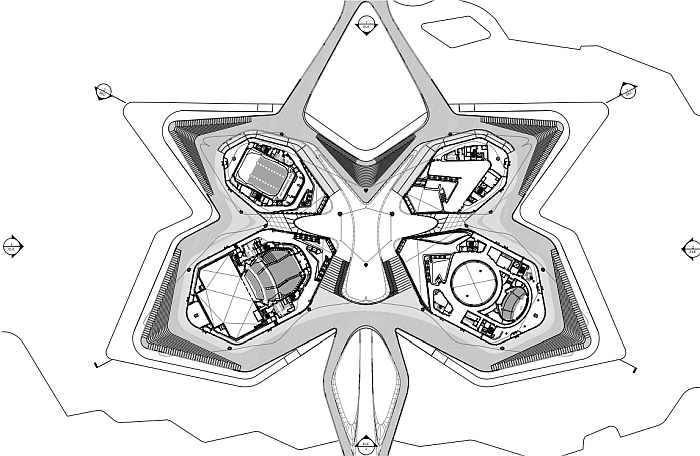
Photo Credit: Zaha Hadid Architects
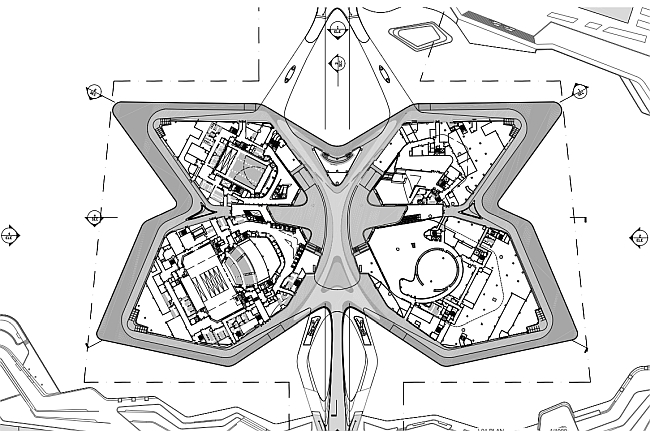
Photo Credit: Zaha Hadid Architects
|


 למרות הכל: ענף האדריכלות והעיצוב בתנועה
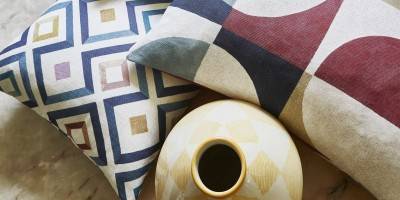 רענון אביבי לבית: מבצעים והשקות לפסח
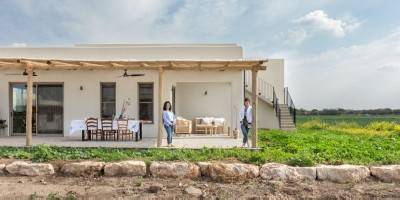 מול הכנרת: בית שמרגיש כמו חופשה - אדריכלות ועיצוב: סטודיו 'רות ולבנה'
 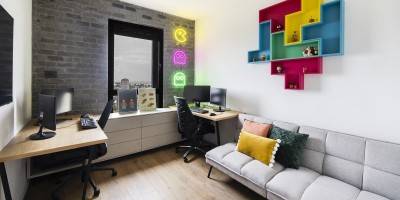 צבע כאמירה של שמחה: השפה האופטימית של סטודיו טולה
 נשים שיודעות לבנות, לעצב ולהוביל
 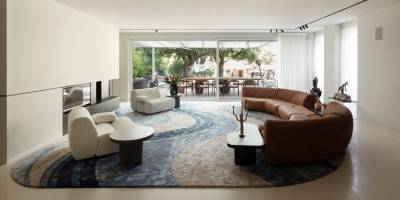 קולקציות 2026 אביב
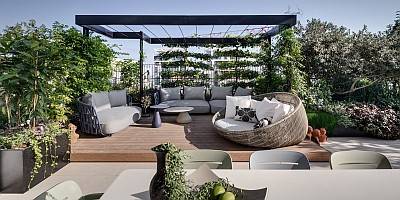 דווקא עכשיו: צאו החוצה מאת שי דוד, מעצב נוף, כרכום
  הגוונים החדשים באקריל - בלורן
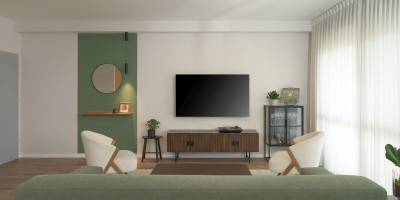 מלון בוטיק פרטי: דירה בראשון לציון שעוצבה כפרק חיים חדש - מעצבת פנים שני חיוט
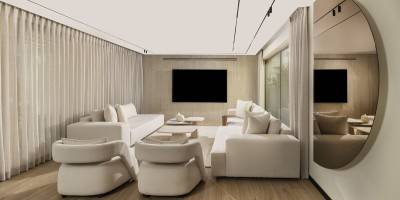 לא רק עיצוב - יצירה מחדש של בית - מעצבת פנים גלית ששון
  הצד השמח של העיצוב: הבחירות שעושות חג בבית
 אהבה על שרטוטים: כשהשיפוץ הופך למבחן הזוגיות
 הוא רצה מודרני. היא חלמה כפרי. והמעצבות? מצאו דרך שלישית
  עולם המטבחים: כל מה שרצית לדעת
 ט״ו בשבט בבית – אדריכלות ועיצוב כדרך חיים המחוברת לטבע


