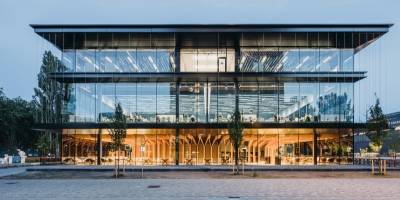
 בניין קמפוס בריא - לאנשים ולפלנטה
|| פרויקטים
בניין קמפוס בריא - לאנשים ולפלנטה
|| פרויקטים
Project Name: Echo, Delft, Netherlands
Location: Delft, Netherlands
Building surface: 8844 m2 GFA
Building site: ca. 4 000m2
Programme: Interfaculty Education facility for all faculties including: Education spaces, lecture hall, study spots and restaurant
Architect: UNStudio: Ben van Berkel, Arjan Dingsté with Marianthi Tatari, Jaap-Willem Kleijwegt, Ariane Stracke and Piotr Kluszczynski, Thys Schreij, Mitchel Verkuijlen, Bogdan Chipara, Krishna Duddumpudi, Fabio Negozio, Vladislava Parfjonova, Marian Mihaescu, Ajay Saini, Ryan Henriksen, Shangzi Tu, Xinyu Wang
Status: Completed
Photos: ©Evabloem / ©Hufton+Crow
Visualisations [CGI]: Plompmozes
1200 פאנלים סולאריים, התקנות חכמות, בידוד טוב ומערכת אחסון חום וקור מבטיחים כי בניין הקמפוס ''אקו'' שתכננו UNStudio יוכל לספק יותר אנרגיה ממה שהוא דורש לפעילותו היומיומית. זה כולל אנרגיה הקשורה למשתמש, כמו צריכת חשמל למחשבים ניידים, תאורה והסעדה. 90% מהרהיטים המשמשים בבניין עברו גם כן שימוש חוזר
Eco, Photo Credit: Evabloem
Eco, Photo Credit: Evabloem
Eco, Photo Credit: Evabloem
Eco, Photo Credit: Evabloem
Transparency was essential to the design of Echo. It not only ensures maximum daylight inside the building [known to have health benefits for the users, but also reducing the need for artificial lighting], it also creates a visual connection to the wider campus and to surrounding nature. As such, a closed-in, ‘institutional’ experience for the users is avoided, while the open and public character of the building connects the two sides of the campus and provides a bright, uplifting and welcoming environment for faculty and students alike.
However, to avoid heat gain, it is also essential to prevent excess sunlight penetration. Overheating of the building is prevented by a combination of sun protection and the low solar penetration factor of the glass. In addition, the deep horizontal aluminum awnings keep out excess solar heat. These canopies are interconnected by cables along which climbing plants form a subtle green facade that filters daylight. To ensure clean air in the building, a plenum floor is installed above hollow-core slabs. Here fresh air is pumped up from the floor, rather than down from above, thus avoiding circulation around the room. The vents for this system, along with the computer floor installation, can easily be relocated, should the layouts of the rooms change in the future.
Not only has a great deal of attention been paid to the environmental impact of the materials used in the construction, but the building has been designed as much as possible according to principles of circularity. Using large portal constructions with large grid sizes, the columns run along the edge of the building, creating column-free spaces with large spans. The steel trusses have standard sizes and can be dismantled so that they can be reused elsewhere after the lifespan of the building. The hollow-core slabs can also be reused in the future.
A building that stimulates movement and collaboration
Echo is an education building with multifunctional spaces that transcends current learning environments. The design supports the contemporary culture of 'Everything Anywhere', where the in-between spaces are also of great importance and physical movement is stimulated. Echo therefore also provides space for unstructured time: a variety of platforms for reflection, inspiration and communication. The interior offers a warm welcome to visitors. At specific positions, bamboo ribs extend along the ceiling, forming an integral part of the design. The crafted look and feel of the bamboo is extended around the central staircase, that in one gesture joins the study and cooperation spaces into one connected world of learning, collaboration and connection. This centrally positioned 'grand stair' facilitates and promotes physical movement through the building and thus contributes to the health of students, researchers and teachers alike.
Eco, Photo Credit: Hufton+Crow


Eco, Photo Credit: Evabloem

Eco, Photo Credit: Evabloem

Eco, Photo Credit: Evabloem

Eco, Photo Credit: Evabloem
A future-proof campus is an active campus. That is why Echo not only connects with the surrounding public space, it also defines it. The adjacent square continues through the transparent ground floor of the building and connects with the street on the other side, turning the ground floor of Echo into a covered public square and a public connector that makes the invisible world of learning a visible and engaging experience.
Two sculptural volumes [the large 700 person lecture hall and the debate space], direct the flow of people across this covered square. The diagonal orientation of these volumes simultaneously defines two large transparent corners, one housing a restaurant with terrace opposite the D:Dreamhall, and the other a large study landscape.
Future-proof: a wide variety of flexible teaching rooms
The 8,844 m2 Echo building provides space for lectures and tutorials, group work, project-based teaching, debates and self-study for around 1,700 students by way of the lecture rooms, classrooms and a variety of study spaces. Echo houses a total of seven teaching rooms, most with a flexible layout. The largest lecture room on the ground floor, which can accommodate 700 people, can be divided into three separate rooms in 15 minutes. This enables multiple lectures or events to take place simultaneously and enables maximum programming of the space.
A similar movable wall system is used in the mixed didactic space on the first level, so that this can be divided into two classrooms of 144 places each when required. The more than 300 study spaces throughout the building can be used for group work and self-study. The various teaching rooms have been designed based on the current and future needs of the lecturers and students. In Echo, the focus is on medium-sized and large teaching rooms, accommodating between 150 and 700 people. In addition to these larger rooms, there is also a case-study room that is particularly suitable for motivational teaching/interaction between lecturers and students. In addition there are four level rooms for project-based teaching, each accommodating almost 70 people.
A modular wall system has been used in the office spaces on the second floor, allowing for future changes to the layout. Should there be demand for functional change in the future, these office spaces can be turned into didactic spaces with minimum interruption.

Eco, Photo Credit: Evabloem

Eco, Photo Credit: Hufton+Crow

Eco, Photo Credit: Hufton+Crow

Eco, Photo Credit: UNStudio

Eco, Photo Credit: UNStudio

Eco, Photo Credit: UNStudio

Eco, Photo Credit: UNStudio
Eco, Photo Credit: UNStudio
 למרות הכל: ענף האדריכלות והעיצוב בתנועה
 רענון אביבי לבית: מבצעים והשקות לפסח
 מול הכנרת: בית שמרגיש כמו חופשה - אדריכלות ועיצוב: סטודיו 'רות ולבנה'
  צבע כאמירה של שמחה: השפה האופטימית של סטודיו טולה
 נשים שיודעות לבנות, לעצב ולהוביל
  קולקציות 2026 אביב
 דווקא עכשיו: צאו החוצה מאת שי דוד, מעצב נוף, כרכום
  הגוונים החדשים באקריל - בלורן
 מלון בוטיק פרטי: דירה בראשון לציון שעוצבה כפרק חיים חדש - מעצבת פנים שני חיוט
 לא רק עיצוב - יצירה מחדש של בית - מעצבת פנים גלית ששון
  הצד השמח של העיצוב: הבחירות שעושות חג בבית
 אהבה על שרטוטים: כשהשיפוץ הופך למבחן הזוגיות
 הוא רצה מודרני. היא חלמה כפרי. והמעצבות? מצאו דרך שלישית
  עולם המטבחים: כל מה שרצית לדעת
 ט״ו בשבט בבית – אדריכלות ועיצוב כדרך חיים המחוברת לטבע
|
|